People trust their church. We take that personally.
Prayer requests, family details, what someone gave. Each is seen only by the people who should, and protected the whole way.
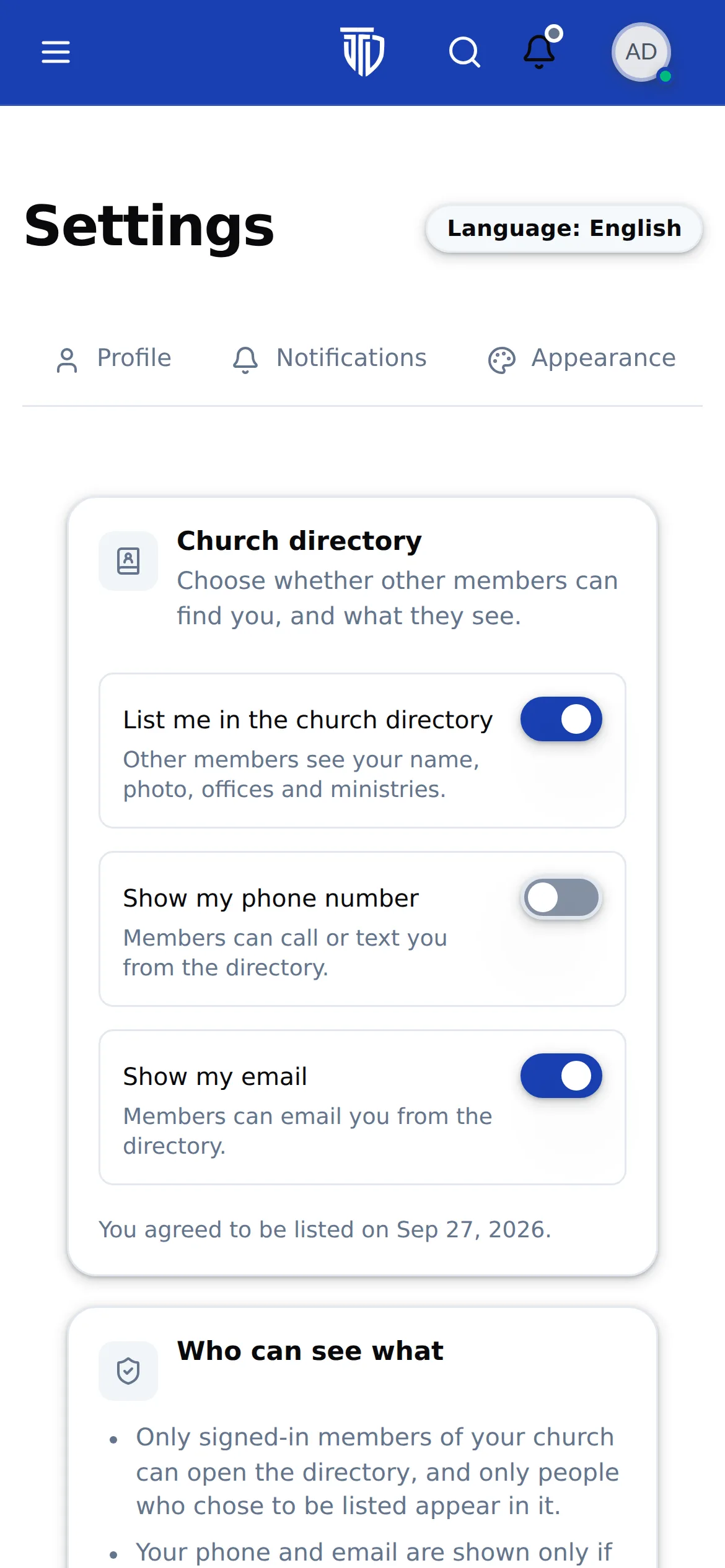
Who sees what.
The same rules apply everywhere data can go: screens, reports, exports, messages and Doki.
| Role | Giving totals | Individual gifts | Member records | Directory |
|---|---|---|---|---|
| PastorThe whole church and pastoral care | Yes | Only if an administrator grants it | The whole church | Opt-in listings only |
| TreasurerRecords gifts, issues receipts and statements | Yes | Yes, to issue receipts | Limited, no pastoral notes | Opt-in listings only |
| Ministry leaderThe ministries they lead | Their ministry's total | No | Their ministry only | Opt-in listings only |
| MemberTheir own record and household | Their own giving | Their own gifts only | Their own and their household's | Opt-in listings only |
Other roles, such as ushers and branch admins, see only what their job needs. An administrator assigns every role, and role changes are recorded in the audit log.
Privacy decided by roles, not by luck.
- Each role sees only what it should
- Pastors, treasurers, ministry leaders and members each get a view sized to their role: in PillarAid, in reports, in exports and in Doki.
- Donor privacy by default
- Pastors see giving totals, not who gave what, unless an administrator grants it. Finance roles see individual gifts so they can issue receipts.
- An opt-in directory
- Nobody appears in the member directory until they say yes, and they choose whether their phone and email are shown. Consent is recorded with a date.
- Church offices are not app access
- Naming someone an Elder or Deaconess doesn't give them a login. App access comes only from the role an administrator assigns.
How your data is protected.
What PillarAid does today, stated plainly. No certificates we don't hold.
- Encryption in transit
- Every connection to PillarAid uses HTTPS with TLS.
- Two-factor sign-in
- Protect accounts with two-factor authentication. Administrators are prompted to use it.
- Audit log
- Important changes to roles, member records, giving and settings are written to an audit log administrators can review.
- Backups
- Church data is backed up regularly so it can be restored if something goes wrong.
- Separated by church
- Every record belongs to one church (and one branch). Queries are scoped on the server, not just hidden in the interface.
- Payments by specialists
- Card and mobile money payments are processed by Paystack and Flutterwave. Card details go straight to them and never touch our servers.
Designed to help you meet your obligations.
Your church is responsible for the personal data it keeps. PillarAid is designed to help you meet the principles of data protection laws across Africa, such as Nigeria's NDPA, Kenya's Data Protection Act, South Africa's POPIA and Ghana's Act 843, and of the GDPR: collecting only what you need, recording consent, limiting who can see what, and letting people's data be corrected or exported.
- Consent
- Directory listing and message opt-outs are recorded per person.
- Minimisation
- Roles limit sensitive fields. Health and pastoral notes stay with pastors and administrators.
- Access and correction
- Members can see and update their own contact details in PillarAid.
- Portability
- Export your church's data whenever you need it.
- Accountability
- The audit log shows who changed what, and when.
This isn't legal advice, and using PillarAid doesn't by itself make a church compliant. Your own policies matter too.
Your data is yours.
We don't sell it, we don't use it to advertise, and you can export it at any time, including on the way out. A church should never be locked into its own directory.
Found a vulnerability?
- Write to
- support@pillaraid.com
- Subject
- Security report
Please tell us privately. Give us a reasonable time to fix it before sharing it publicly, don't access more data than you need to show the problem, and we'll keep you updated as we work on it.
Security, answered.
PillarAid runs on established cloud infrastructure. If your church has specific data-residency requirements, talk to us before you sign up and we'll answer in detail.